-black.svg)
Most founders put off SOC 2 certification until after product-market fit, a Series A raise, or after they hire more staff. It's easy to kick the can down the road, and the forcing function is almost always a deal.
A procurement team needs a SOC 2 report before moving forward, or an enterprise customer won't sign until they've seen a security review. By this point, businesses are looking at six to twelve months of work.
In contrast, when security is built into how a business operates from the start, compliance follows naturally.
Who Is This SOC 2 Guide For?
This guide is for founders and leadership teams. You don't need to speak fluent security, you just need a business that's about to get asked for a SOC 2 report, ready or not.
What Is SOC 2 and Why Does It Matter?
SOC 2 comes up in almost every conversation with enterprise buyers. It's a security standard developed by the AICPA, the organization that sets accounting and auditing standards in the US, that defines how companies should manage and protect customer data. Unlike a self-reported security questionnaire, SOC 2 involves an independent third-party auditor who verifies that the security controls a company claims to have are actually in place and working.
There are two report types of SOC 2. Type 1 is a snapshot that confirms your controls are correctly set up at a given point in time. Most buyers who require SOC 2 require Type 2, which is why the timeline can come as a surprise. A company earns Type 2 only after 3 to 12 months of monitoring, proving the controls hold up over time, not just on paper.
For companies selling into insurance, finance, or healthcare, buyers need to verify a seller's security controls are real before they'll sign. More recently, most B2B SaaS companies, regardless of industry, are now being asked for the same level of rigor.
Buyers check sellers' security controls via vendor risk assessment. Before a deal closes, the buyer's security or procurement team sends over a questionnaire covering the seller's infrastructure, access controls, and data handling, confirming the data won't be mishandled or exposed.
That questionnaire can run 300+ questions deep. A detailed SOC 2 report is what gets most companies through most of them without starting from scratch every time.
Why Timing Matters
The SOC 2 process is more involved than most people expect. Before a SOC 2 auditor gets involved, leadership teams need to map every system their data lives in and draw a boundary around what will be included in the audit. From there, policies and procedures need to be documented, controls configured across the tool stack, and evidence collected that everything is working as intended. Templatized policies exist and are a perfectly fine starting point, but they still need to be customized to reflect how the business actually operates. And if a company chose its tools early without compliance in mind, it may need to upgrade tiers or rethink its stack before audit prep can even begin. Start to report issued, a typical SOC 2 Type 2 timeline runs six to twelve months.
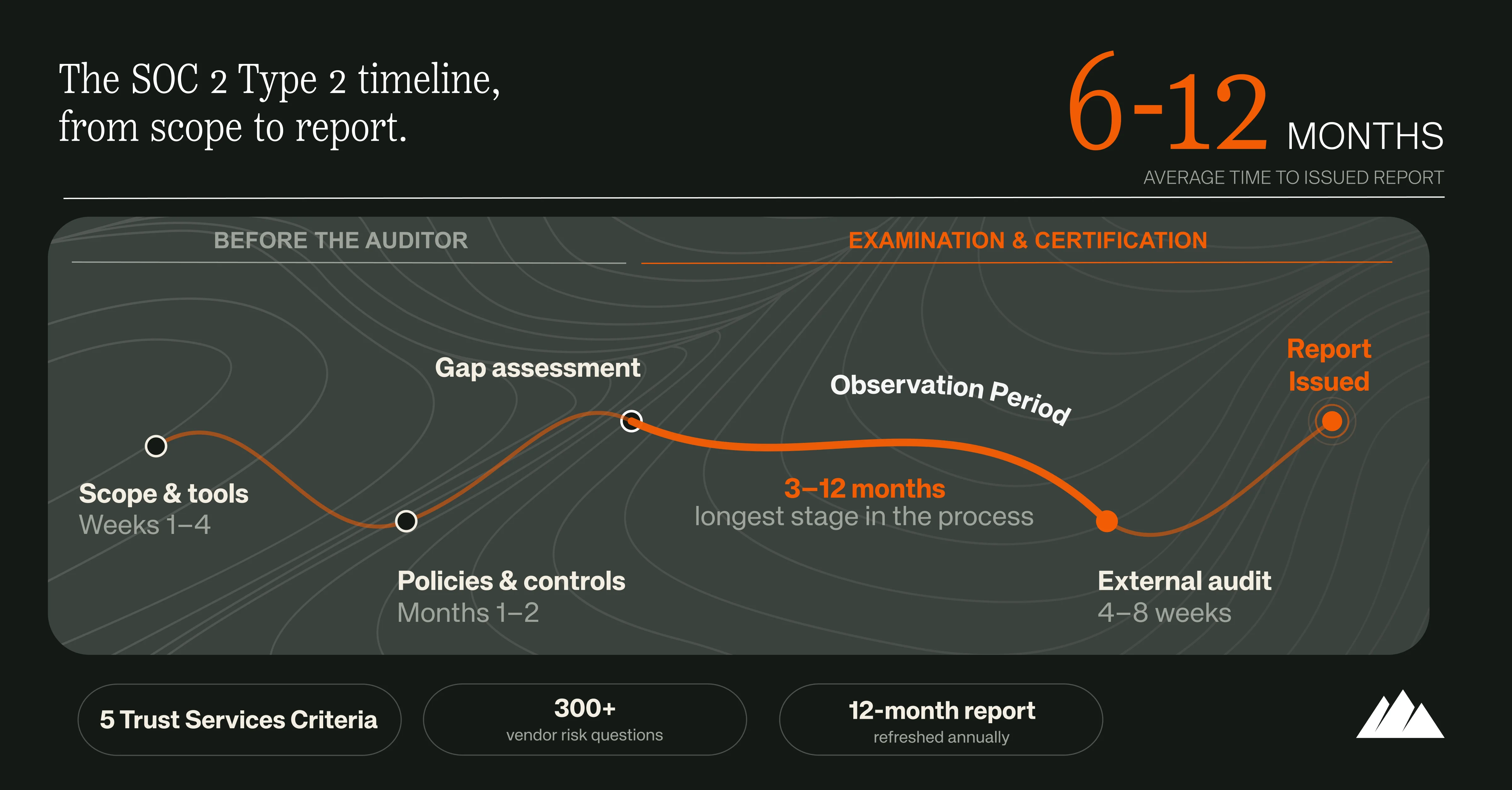
Founders who managed the SOC 2 process internally tend to say the same thing: they wish they had started sooner and outsourced it from the start. By the time leadership teams engage with the process, they are already in the middle of a deal, managing significant engineering and sales work alongside everything else. SOC 2 pulls them away from the two things that matter most: building the product and connecting with customers.
What SOC 2 Actually Costs
The time investment is just one part of the cost equation. SOC 2 involves several layers of expenses that operators consistently underestimate.
Costs leading up to the SOC 2 audit:
One of the first potential costs to consider comes from the tool stack. Freemium and entry-level plans typically skip the features compliance needs: single sign-on, advanced audit logs, the ability to download a vendor's own SOC 2 report. Those live on business or enterprise tiers, and upgrading Salesforce, HubSpot, and Snowflake all at once adds up fast. It’s also worth knowing that some vendors gate single sign-on (SSO) specifically behind the pricier 'Enterprise' tiers bundled with features you don't need, which can push the real cost well past what you'd expect.
Time is easy to underestimate too. It's not just the hours spent writing policies or configuring access controls. It's the engineering hours pulled off the product roadmap, the leadership hours spent in readiness meetings, and the ongoing maintenance once a company is certified.
And before the real audit starts, there's the gap assessment, an internal dry run a company does on itself first. Skip it, and security gaps surface mid-audit instead, adding time, review cycles, and cost.
Costs from the SOC 2 the audit itself:
Audit costs vary, and scope drives most of the variation. A mid-range SOC 2 audit typically runs $10,000-$15,000, while a more complex, enterprise-grade audit can cost $30,000-$50,000. How many systems a company's data touches, and how tangled those flows are, decide where a company lands.
Every tool a business uses, accounting software, a customer database, a cloud storage platform, is a system an auditor may need to review. More tools means more data flows. More data flows means more evidence for an auditor to collect, which is what drives the cost up.
A simple business running everything through Google Workspace, Slack, and a CRM like HubSpot has a narrow scope. Two or three systems, and that's it. An AI-powered company spreading data across AWS, Cloudflare, and a dozen other platforms is a different animal entirely. Every one of those flows has to be tracked, documented, and audited.
Costs after SOC 2 certification:
Most initial budgets skip what comes after: annual re-audits, continued tooling costs at enterprise tiers, and the internal time it takes to keep the program running.
Once the report is issued, the work doesn't stop. Onboarding and offboarding, access reviews, org chart updates, network diagram maintenance, risk library management. None of it is a one-time task. It recurs weekly, monthly, yearly.
Whatever budget you're working with, invest your resources intentionally, and build in some buffer so compliance milestones don’t slow your deals.
Every Tool Is a Double-Edged Sword
Most teams don't think of their tool stack as a security surface. They add what they need as they need it, and by the time an auditor asks to see the full picture, the list is longer than anyone expected.
Take Figma. Most teams use it for design work and never think twice. But if that account holds something proprietary — e.g., a product announcement two months out — and it gets compromised, the roadmap could land in a competitor's hands before the company has had a chance to tell its own customers. The data doesn't have to be financial or personally identifiable to be sensitive; it just has to matter.
Choosing the Right Audit Partner
The firm that conducts the audit shapes the outcome as much as the preparation does. Big Four firms feel like the safe choice when the stakes are high; it’s essentially insurance on the outcome. That instinct makes sense when compliance is on the line.
These economics rarely hold up for growth-stage companies, though. Large firms typically charge two to four times as much as boutique firms, and a meaningful part of that premium goes towards brand recognition rather than better outcomes.
The quality difference comes down to who actually does the work. At a large firm, a project of this size often gets assigned to junior associates managing multiple engagements at once. At a boutique firm, there is more direct attention, more time spent understanding the specific business, and a partnership model rather than a transactional one.
In fact, many boutique firm leaders start at the Big Four. They gained experience, learned what they needed, and then started their own firms. The talent doesn’t stay at the big firms forever.
The more useful question when evaluating a firm for the audit is not how well known they are; it is who specifically will be on the engagement, and how well they understand the client’s business.
Where to Start With SOC 2: Practical First Steps for Growing Companies
Regardless of which firm handles the audit, the groundwork is the same. Here are some quick wins to get started:
- Enable MFA (multi-factor authentication) across every tool in the stack, including ones that feel low-risk like Zapier or Slack. Most tools have MFA built in, and it just needs to be switched on.
- Check the plan tier for each tool. Vendor SOC 2 reports are typically only accessible at business or enterprise tiers, and that access matters during the audit.
- Get organized. An org chart, documented policies and procedures, and completed background checks are baseline requirements for SOC 2. Templatized policies are a fine starting point and can be customized from there.
- Start before a customer asks. The companies that treat security as an ongoing discipline rather than a compliance project rarely find themselves in a reactive position.
Security First, Compliance Follows
Everyone needs security. Not everyone needs compliance. Most companies get it backwards and spend months pursuing a SOC 2 certification before the actual security foundation is in place.
When security is done right, compliance follows naturally. The same controls that protect data, enforce access policies, and keep systems properly configured tend to satisfy the requirements for SOC 2, HIPAA, and CMMC. A strong security practice covers the ground that compliance audits are checking for anyway.
Whether certification is ever needed depends on who the customers are. For companies selling to enterprise buyers or into insurance, finance, or healthcare, security has to be part of how the business is built from day one. How people are hired, how they are trained, what tools are chosen. Treeline's own approach to this is documented at our Trust Center.
SOC 2 FAQs: Still With Us?
What is SOC 2 compliance?
SOC 2 compliance is a security standard developed by the AICPA that defines how companies should protect customer data across five Trust Services Criteria. For companies selling into insurance, finance, or healthcare industries, it’s less an option and more a baseline requirement.
What is the difference between SOC 2 Type 1 and Type 2?
SOC 2 Type 1 is a snapshot that confirms your security controls are properly designed at a given point in time. SOC 2 Type 2 covers an observation period of 3 to 12 months, proving that your team actually follows those controls consistently over time. Most buyers who require SOC 2 require Type 2.
What is the difference between SOC 1, SOC 2, and SOC 3?
SOC 1 focuses on financial reporting controls and applies only if you're directly involved in your clients' financial statements. SOC 2 covers information security and is the standard most commonly required by enterprise buyers and regulated industries like insurance, finance, and healthcare. B2B SaaS companies outside those industries are increasingly being asked for it as well. SOC 3 is a simplified public-facing version of a SOC 2 report that can be shared freely without an NDA, often used for marketing and trust-building.
What are the SOC 2 Trust Services Criteria?
Security, Availability, Processing Integrity, Confidentiality, and Privacy. Security is the only mandatory one; most companies start with Security only. The others are optional and should be selected based on your specific business model and your customers' requirements.
What is a SOC 2 gap assessment?
A gap assessment, sometimes called a readiness assessment or mock audit, is what you run before bringing in an external auditor. Unlike the formal audit, this one can be done internally, with a compliance consultant, or through a compliance platform. The goal is to find missing controls, undocumented data flows, and process gaps before an auditor does, saving you time and money.
What is the relationship between security and compliance?
Security is how a business protects its data. Compliance is how it demonstrates to customers and auditors that those protections meet a defined standard. Every business needs security. Not every business needs compliance. When the right access controls, policies, and security configurations are already in place, compliance is mostly a matter of documenting and verifying what exists.